

Skip to content

PolyPunica®

PolyPunica® | ≥ 70% Standardized Total Polyphenols

Product Type

Polyphenol-Standardized Pomegranate Peel Extract

Active Content

≥70% Total Polyphenols

Form

Powder

Key Feature

Clean-label botanical ingredient with standardized polyphenol content.

Total Polyphenol

The pomegranate (Punica granatum) is among the valuable plant sources distinguished by their natural polyphenol content. The peel released during the processing of the fruit not only accounts for a substantial share of total fruit weight but is also one of the principal fractions in which polyphenols are concentrated.

PolyPunica is a standardized pomegranate peel extract produced by the revalorization of the peels obtained from pomegranate processing operations and their passage through controlled extraction, purification, and enrichment stages.

Polyphenols are a broad group of bioactive compounds synthesized naturally by plants. Pomegranate peel is a plant matrix particularly rich in hydrolyzable tannins and in the phenolic constituents associated with them.

At the center of PolyPunica’s standardization stands: ≥70% TOTAL POLYPHENOL.

BIOACTIVE PROFILE 

 A Natural Matrix Rich in Polyphenols

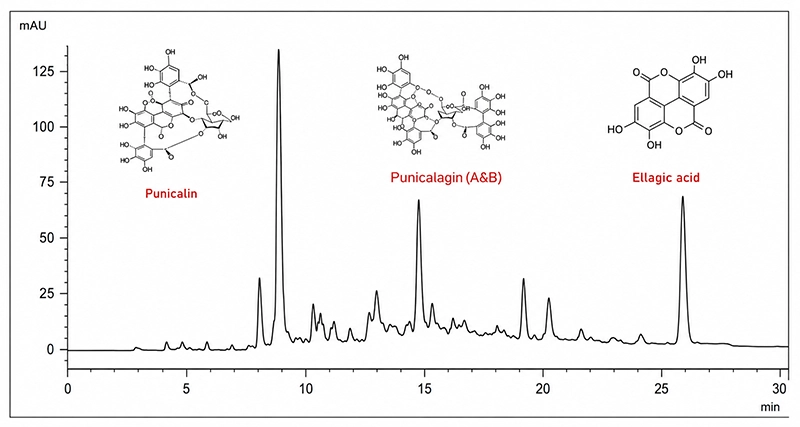
While Total Polyphenol constitutes the product’s principal positioning, punicalin, punicalagin A&B, and ellagic acid are the constituents that come to the fore in defining the extract’s characteristic bioactive profile.

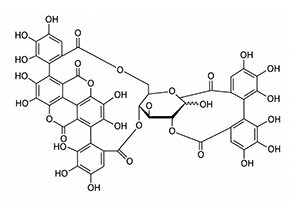
PUNICALAGIN A & B

This is one of the pomegranate's characteristic high-molecular-weight ellagitannins and occurs naturally in the form of the A and B isomers. In PolyPunica, these two forms are tracked analytically in conjunction.
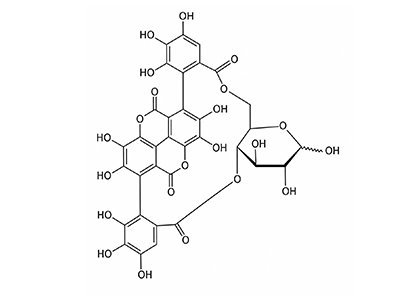
PUNICALIN

One of the characteristic ellagitannins of pomegranate peel. It constitutes one of the significant components of PolyPunica's defined punicoside profile.
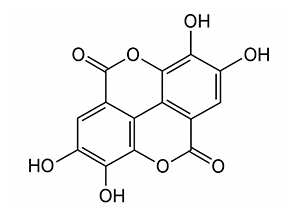
ELLAGIC ACID

A characteristic polyphenol occurring naturally in pomegranate peel and associated with ellagitannin structures. It is one of the fundamental constituents defined analytically within PolyPunica's standardized profile.
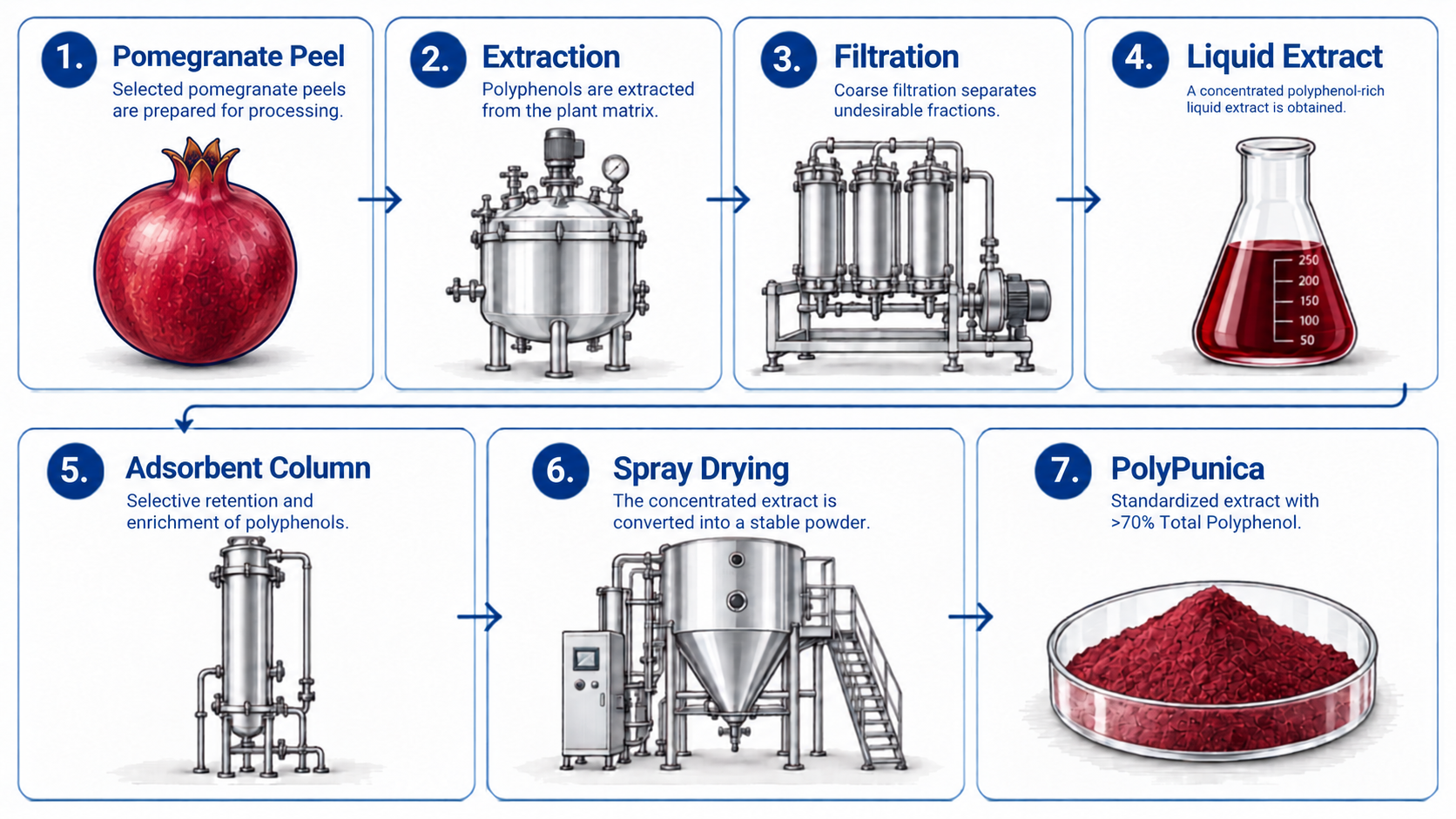
PolyPunica production process: pomegranate source, extraction, filtration, liquid extract, adsorption, spray drying and standardized polyphenol powder.
↗ Click or tap to view the process diagram in detail

STANDARDIZATION 

 From a Natural Source to a Measurable Bioactive Profile

Controlling naturally occurring variability in botanical extracts is of critical importance to the continuity of product quality.

In PolyPunica, the production process is directed not merely at obtaining an extract but at establishing a defined and measurable polyphenol profile.

Constituent Extract Content
Punicalin 21.7%
Punicalagin (A+B) 14.5%
Ellagic Acid 7.8%
Total Punicosides 44.0%
Other Polyphenols 30.0%
Total Polyphenol 74.0%

Analytical Verification

The characteristic constituent profile is verified by chromatographic analyses, and the total polyphenol content by appropriate analytical methods. This approach ensures that PolyPunica is defined not by its botanical source alone, but by its measurable chemical profile.

ANTIOXIDANT CAPACITY 

Not a Single Test but a Multifaceted Analytical Assessment

Rather than being predicated upon a single method, PolyPunica’s antioxidant capacity has been characterized through four distinct analytical approaches: DPPH, ORAC, FRAP, and ABTS.

DPPH | Free radical scavenging capacity

Assesses the capacity of an antioxidant system to neutralize stable free radicals.

PolyPunica: IC₅₀ = 0.004 ± 0.0004 mg/mL

A decrease in the IC₅₀ value denotes a higher radical scavenging capacity.

ORAC | Antioxidant capacity against peroxyl radicals

Assesses the protective capacity afforded by antioxidant constituents against peroxyl radicals.

PolyPunica: 7035 ± 206 µmol TE/g

FRAP | Reducing capacity

Assesses the capacity of antioxidant constituents to donate electrons and to reduce oxidized structures.

PolyPunica: 7820 µmol TE/g

ABTS | Radical neutralization capacity

Permits the assessment of the capacity of antioxidant constituents of differing chemical properties to neutralize radical cations.

PolyPunica: 2.87 ± 0.08 mmol TE/g

ANTIBACTERIAL POTENTIAL

The characteristic polyphenol matrix of pomegranate peel is likewise under assessment in terms of its potential for interaction with microbial systems.

PolyPunica’s high total polyphenol content, together with characteristic constituents such as punicalin, punicalagin A&B, and ellagic acid, presents a robust bioactive profile for the investigation of the product’s antibacterial potential.

GREEN CHEMISTRY 

 Effective Extraction, a Cleaner Process Approach

PolyPunica’s production approach is directed not merely at attaining a high polyphenol content, but at achieving this by way of a more controlled process of reduced environmental burden.

A water-based extraction approach is employed in production. The purification and enrichment stages support the selective concentration of the polyphenols.

Fundamental principles

  • Water-Based Process – Water is one of the principal extraction media of the process.
  • Avoidance of Toxic Solvents – The use of toxic organic solvents is avoided in the process design.
  • Resource Efficiency – The selective separation and concentration of valuable polyphenols is the objective.
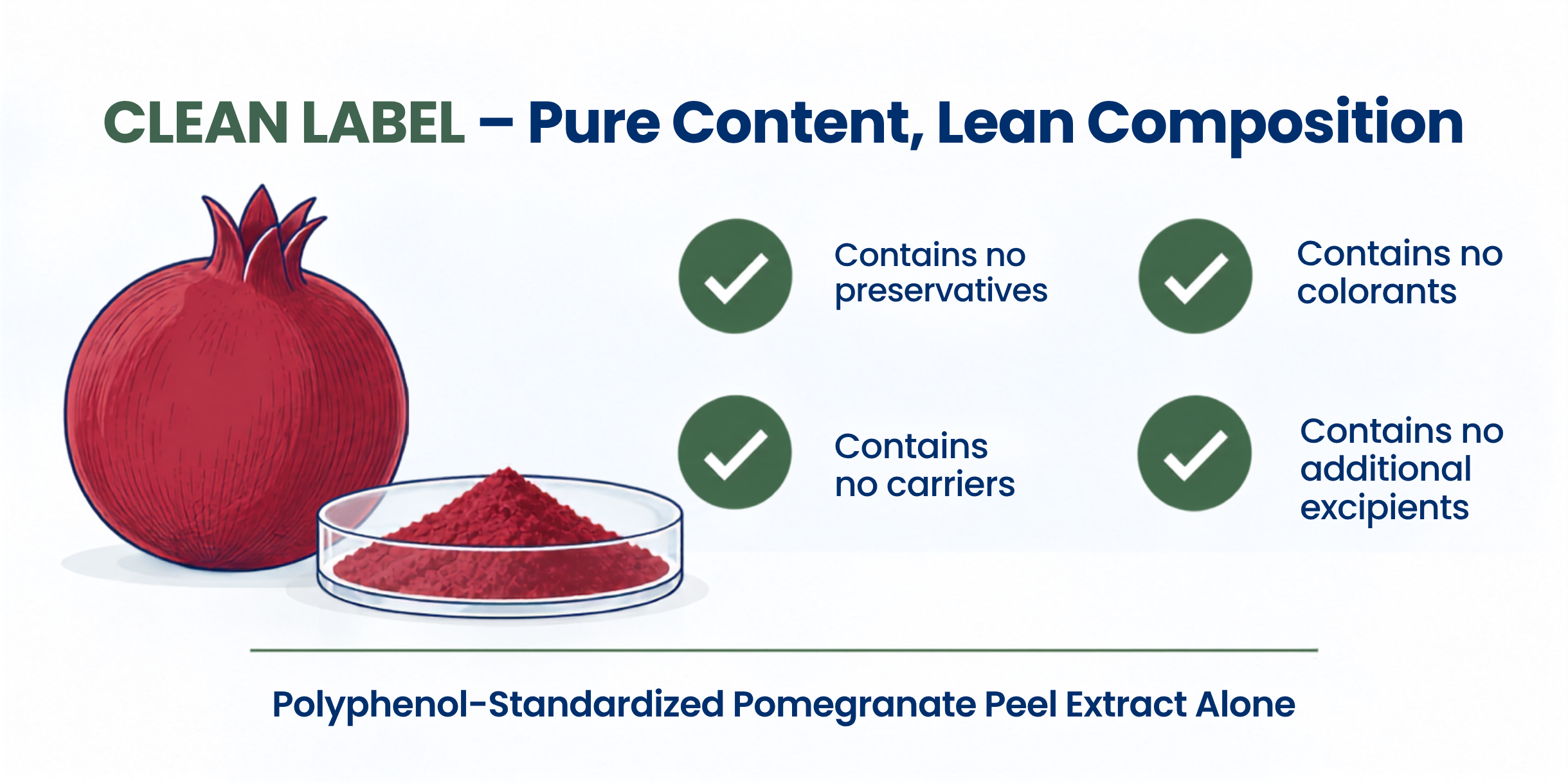
CLEAN LABEL — Pure Content, Lean Composition

PolyPunica contains pomegranate peel extract only, with no added excipients.

  • Contains no preservatives
  • Contains no colorants
  • Contains no carriers
  • Contains no additional excipients

Polyphenol-Standardized Pomegranate Peel Extract Alone

QUALITY & DOCUMENTATION — Assured from Production to Analysis

PolyPunica’s quality approach does not consist of finished product analyses alone. Production infrastructure, product attributes, and technical documentation are assessed in conjunction, forming a comprehensive quality system.

PRODUCT ATTRIBUTES

  • Halal
  • Vegan
  • Allergen
  • Botanical Source
  • Clean Label

ANALYSIS & DOCUMENTATION

  • Certificate of Analysis (COA)
  • MSDS
  • Composition List
  • Heavy Metal Analysis
  • Microbiological Analysis
  • Pesticide Residue Analysis
  • Supporting Documents

The quality and documentation infrastructure required from technical assessment through to product development.

SUSTAINABILITY

 From Nature to the Future

PolyPunica’s story concerns not only polyphenols, but also the manner in which the source is put to use.

Pomegranate peel, which arises following pomegranate processing operations and which for the most part remains a low-value by-product, is transformed by the PolyPunica production approach into a high-value-added bioactive raw material.

  • Upcycling: Rather than remaining waste or a low-value by-product, pomegranate peel is revalorized and transformed into a value-added product.
  • Circular Economy: The reintroduction of an already produced biological resource into the production cycle.
  • Resource Efficiency: Drawing upon the natural by-product of existing pomegranate production rather than cultivating a new botanical source.
  • Green Production: The combined use of a cleaner extraction approach and controlled process technologies.
  • Environmental Footprint: An approach directed at reducing the environmental burden by way of by-product valorization and a diminished need for new raw material production.

Rather than disposing of a by-product, we restore the value within it to the production cycle

APPLICATION & PRODUCT DEVELOPMENT — From PolyPunica to the Finished Product

PolyPunica’s concentrated polyphenol profile and standardized powder structure present a flexible raw material platform that may be employed across differing product development approaches.

Functional Food

Functional Food

Functional Beverage

Functional Beverage

Tablet

Tablets

Capsule

Capsules

Gummy

Gummies

Sachet

Sachets

Liquid Products

Liquid

A Paediatric Real-World Study of a Combined Formulation Containing PolyPunica

A multicentre, retrospective and observational study published in 2026 evaluated routine clinical records from 128 children aged 4–10 years who had been diagnosed with influenza. The analysis compared standard antiviral treatment alone (n=64) with standard antiviral treatment plus a combined Ocean Polyphenols formulation (n=64).

Study Product

The daily combined formulation reported in the publication contained 25 mg of standardized pomegranate-peel polyphenols (PolyPunica), 400 IU of vitamin D3, 50 mg of vitamin C and 7.5 mg of zinc.

Reported Observations

On Day 3, symptom-free rates were higher in the combined-formulation group across all seven assessed parameters; all reported comparisons had p<0.001. Mean time to fever resolution was 1.84 days in the combined-formulation group and 4.50 days in the antiviral-only group. Additional healthcare visits and antipyretic use on Day 3 were also reported less frequently in the combined-formulation group.

Study Limitations

This study was retrospective and observational and does not establish causality. The evaluated product was a combined formulation containing PolyPunica, vitamin D3, vitamin C and zinc; the reported findings cannot be attributed to PolyPunica alone. This content is provided for scientific information and is not diagnostic or treatment advice.

Reference

Güzeloğlu E, Arıca V, Ateş B, et al. Effect of Combined Polyphenol on the Disease Course in Children Diagnosed with Influenza. Pharmaceutics. 2026;18(7):858. DOI: 10.3390/pharmaceutics18070858.

A single raw material, a range of product development possibilities.

Technical Documentation

Documents & samples, on request

Request product documents, samples or formulation guidance directly from our team.

Contact the team