
Lower-Impact Agriculture
Black seed requires neither high energy consumption nor intensive machinery during cultivation. Cold pressing preserves this advantage without chemical solvents.

BioQuinone is a black seed oil product obtained from Türkiye-sourced Nigella sativa seeds by means of controlled cold-press technology, and whose thymoquinone (TQ) content can be standardized for differing intended uses. Throughout the production process, controlled processing, storage, and stability management procedures are applied in order to preserve the oil matrix and its bioactive constituents, whereby the quality attributes and standardization level of the product are secured.
Botanical Oil
Oil
Plant-derived oil ingredient developed for functional and nutritional formulations.
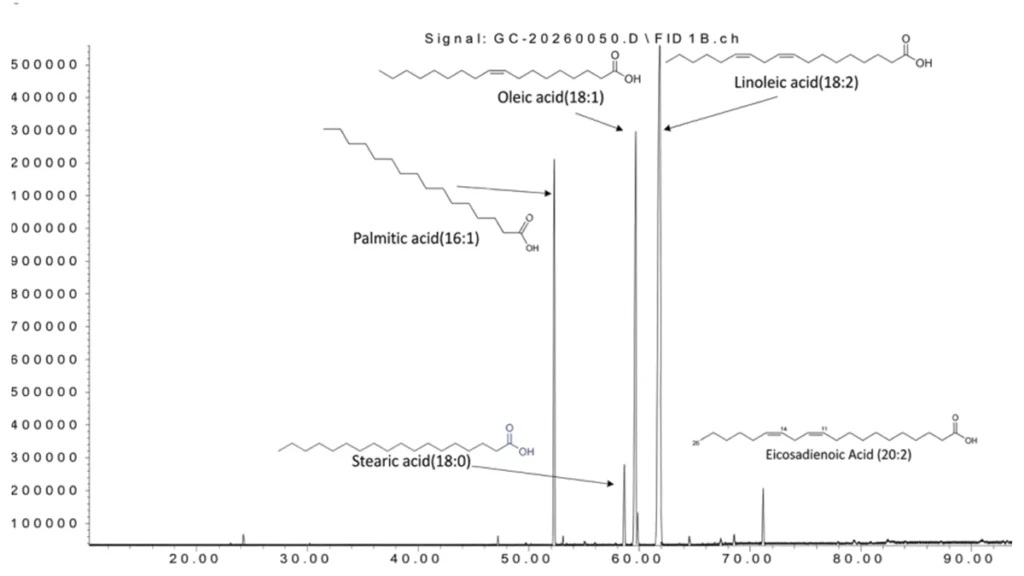
The characterization of BioQuinone is performed through comprehensive analytical work encompassing thymoquinone quantification, fatty acid profile analysis, volatile constituent profiling, and the assessment of the relevant quality parameters. Fatty acid profile analyses demonstrate that the product possesses the lipid composition characteristic of Nigella sativa and contains a high proportion of unsaturated fatty acids. These findings serve as significant quality indicators for confirming the product’s constituent profile and for assessing batch-to-batch consistency.
Volatile constituent analyses have revealed that, alongside thymoquinone, BioQuinone possesses a characteristic volatile profile comprising p-cymene, α-thujene, terpinen-4-ol, α-pinene, and further phytochemical constituents. This comprehensive analytical characterization approach makes it possible to define the product’s compositional profile, to verify its quality attributes, and to conduct the production process under control.
Underpinned by standardization, analytical characterization, stability assessments, and quality control processes, BioQuinone is a black seed oil product that can be manufactured at differing thymoquinone standardization levels, with a defined constituent profile, verified quality attributes, and assured batch-to-batch consistency.
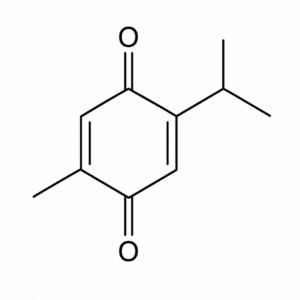
Thymoquinone is a quinone compound of monoterpene structure isolated from Nigella sativa seeds. Chemically a lipophilic and redox-active molecule, TQ has attracted considerable attention and has been investigated for antioxidant and anti-inflammatory activity, as well as chemoprotective effects in experimental models. Studies have demonstrated that TQ is capable of reducing oxidative damage at the cellular level, of suppressing membrane lipid oxidation, and of inhibiting eicosanoid production. It is further reported that TQ supports cellular homeostasis, thereby protecting cells against oxidative stress, and exhibits a chemoprotective effect in various experimental models.
Thymoquinone is regarded as one of the foremost indicators of black seed quality. Its content varies according to the origin of the plant, the harvest period, and the production method; standardized thymoquinone content is therefore the fundamental factor determining the value of a black seed product.
BioQuinone production commences with the intake of certified seeds from a controlled source and their clearing of foreign matter. The cleaned seeds are pressed in a cold press by mechanical pressure alone, without recourse to heat or chemical solvents, whereby the heat-sensitive thymoquinone of the black seed is preserved. The crude oil thus obtained is left to settle so that its sediment may precipitate, and is subsequently clarified by filtration, though not refined. Every batch is analyzed for thymoquinone content, fatty acid profile, and essential oil values, and is placed on record with certificates of analysis (CoA). Finally, the oil is stored in a manner impervious to light.
Cold pressing is a natural production method in which oil is obtained from plant seeds by mechanical means alone, without the application of external heat and without the use of chemical solvents. In this method, the seeds are pressed under controlled conditions using dedicated mechanical press systems, and the oil is thereby obtained. Unlike production methods involving elevated temperatures and chemical extraction processes, cold-press technology assists in preserving the natural structure of the raw material. The product consequently retains to a large degree the characteristic constituents and natural properties particular to its source.
R&D and quality control processes have been standardized. By virtue of our BioQuinone TQ levels, you attain the same active substance level in every production run and ensure the efficacy of your finished product throughout its shelf life.
High Performance Liquid Chromatography (HPLC) is an analytical method of high sensitivity and reliability, widely employed for the separation, identification, and quantification of constituents. The chromatograms obtained in HPLC analyses display the characteristic distribution of the constituents within the sample while also permitting thymoquinone to be determined quantitatively and product quality to be verified.
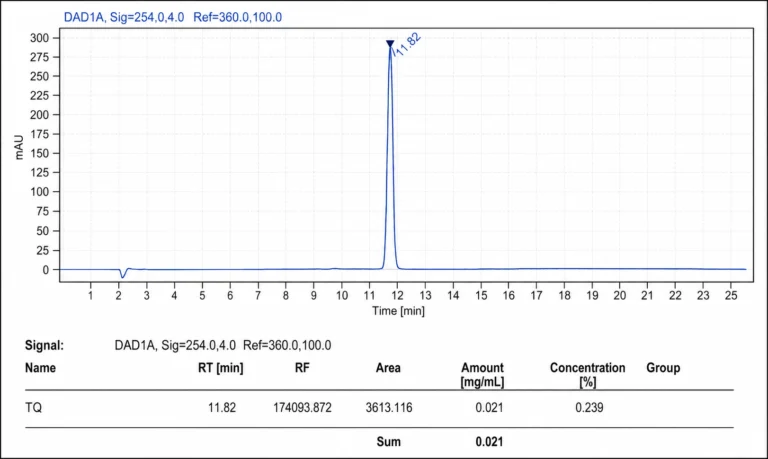
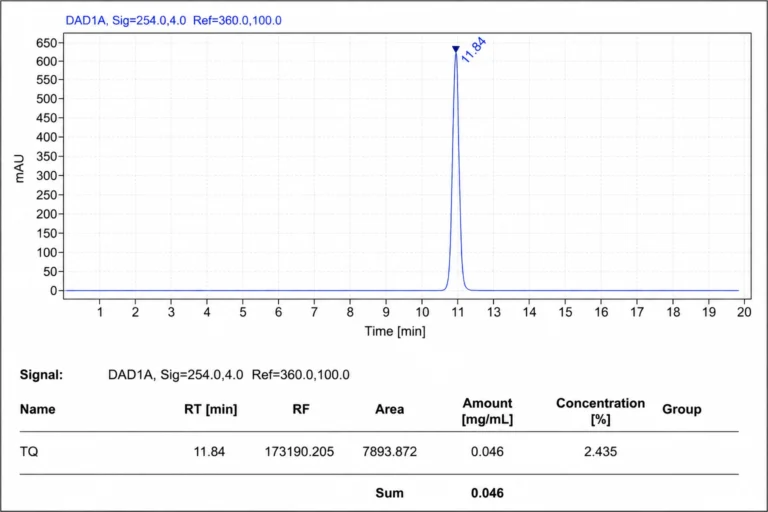
The fatty acid profile of BioQuinone was determined by gas chromatography. According to the analytical results, the fatty acid profile is composed predominantly of unsaturated fatty acids, the total unsaturated fatty acid proportion standing at approximately 85%.
| Fatty Acid | Evaluation Range | Result |
| Linoleic Acid (18:2-Omega-6) | 45–61% | 55.4% |
| Oleic Acid (18:1-Omega-9) | 20–30% | 23.7% |
| Palmitic Acid (16:0) | 6–15% | 12.1% |
| Stearic Acid (18:0) | 3–6% | 3.4% |
| Eicosadienoic Acid (20:2-Omega-6) | 2–4% | 2.4% |
| Total Unsaturated Fatty Acids | 78–85% | 82.5% |
| Total Saturated Fatty Acids | 12–20% | 15% |
| Nutrient | 5 mL |
| Energy | 188 kJ / 45 kcal |
| Fat | 5.0 g |
| Unsaturated fat | 4.25 g |
| Saturated fat | 0.75 g |
| Carbohydrate | 0 g |
| Protein | 0 g |
| Salt | 0 g |
OUR SUSTAINABILITY APPROACH
Black seed’s naturally low-input agricultural profile is supported by solvent-free cold pressing, controlled sourcing and resource-efficient production.
Black seed requires neither high energy consumption nor intensive machinery during cultivation. Cold pressing preserves this advantage without chemical solvents.
Low water demand and high drought tolerance position black seed as a resilient resource under changing climate conditions.
Certified seed, controlled fertilizer management and independent accredited analyses support low-impact production, soil and water protection, and products with no detected pesticide residue.
Every stage—from sowing and harvest to storage and cold pressing—is recorded. Sustainable land management and long-term grower relationships support quality continuity and security of supply.
Black seed cake remaining after cold pressing is returned to the economy as animal feed and organic fertilizer.
Supporting active production and the preservation of agricultural land promotes responsible resource use and a more resilient agricultural ecosystem for future generations.
Technical Documentation
Request product documents, samples or formulation guidance directly from our team.